 Nederlandse versie
| Last modified: Sunday May 20th, 2001 |
Some dolphin basics |

Dolphin Basics, Table of Contents |
||
|---|---|---|
| Basic
orientation Blowhole Eyes and ears |
Rostrum Fins Skeleton |
Genital
area Melon and echolocation |
In the descriptions of dolphins you can come across some terms that indicate relative positions of body parts. A short review:
Blowhole |
|
| Whales and dolphins must come to the surface to breath. In the course of evolution, the nostrils of the whales moved to the top of their head to make breathing at the water surface easier. In toothed whales, the air passages and the nostrils fused into a single air canal and blowhole. The blowhole is closed by a strong valve, which opens briefly for a fast exhalation and inhalation. Below the blowhole there is a system of air sacs, which help in closing the blowhole and which also play a role in sound production. | 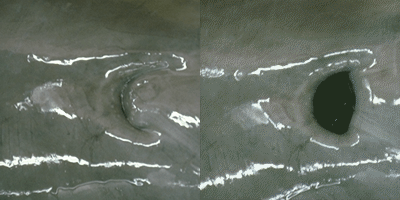 |
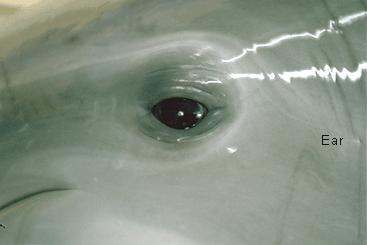
Bottlenose dolphins can see equally well above and under water. The dolphin eye is optimised for underwater vision. In the human eye, most of the refraction is done by the cornea, while additional focussing is done by the lens. Underwater the human eye loses most of its refractive power and the lens cannot compensate for that. Underwater we cannot get a clear picture: we are extremely far-sighted underwater. In the dolphin eye, the refractive power of the lens has become greatly increased, because the lens is located further forward and is completely spherical. The dolphin eye looks a lot like a fish eye.
The dolphin pupil is rather special: instead of a round hole that narrows in bright light, there is a kind of "lid" (called operculum) that slides down, covering the centre of the pupil, leaving narrow slits on its edges in bright light conditions. These narrow slits may give the dolphin more depth of vision above water and therefor better vision. Special adaptations in the edges of the lens may also improve above water vision.
The dolphin retina is organised differently than most mammal eyes: instead on one high-sensitivity area (or yellow spot), the dolphin eye has two such areas. One may be associated with forward vision and the other with lateral (sideways) vision.
Dolphins have tiny external ear openings, which are barely visible, just behind the eyes. These openings probably have no or only a limited function in hearing. The acoustic faculty in dolphins is well developed. The auditory systems in the brain are highly developed and much larger than for instance in humans. This strong development of the auditory systems of the brain is at least in part an explanation for the large brains in dolphins. The auditory nerve has double the amount of nerve fibres compared to the human auditory nerve. Bottlenose dolphins can hear sounds with frequencies between 75 Hz and 150 kHz (in humans the range is 10 Hz to 16-20 kHz). Dolphins are most sensitive for sounds between 40 and 70 kHz. In dolphins, the sound is conducted to the middle ear mainly via the blubber, which is an excellent sound conductor, and the lower jaw. The lower jaw of the dolphin is filled with a fatty tissue, which conducts sound quite well. This tissue extends from a thin area of the lower jaw to the inner ears. Experiments in which a sound-absorbing hood of neoprene was placed over the lower jaw showed that dolphins with the hood in place had considerable difficulty hearing. The middle ear cavities of dolphins are independently suspended and surrounded by air-filled spaces. This reduces the contact with the surrounding bone and can probably help the dolphin in directional hearing. The middle ear in dolphins serves 2 functions: one is to stiffen the sound transmission system, optimising it for high frequencies. The other is to balance the pressure between the inner ear and the external environment. The pressure of a given sound in water is about 60 times as high as the same sound intensity in air.
Rostrum |
|
 |
This picture is included because it shows a number of things:
|
Fins |
||

|

|

|
| dorsal fin | pectoral fin or flipper | tail flukes |
Dolphins have 3 types of fins:
|
||
A dolphin's skeleton has undergone a number of adaptations. The skull has become telescoped (elongated) so that the jaws extend well beyond the nasal passage (the blowhole). The number of fused neck vertebrae is less than in land mammals, which gives them a greater flexibility of the neck. The front limbs have been flattened into flippers, but these still have the same basic structure as our arms and hands. The hind limbs have been lost, at least externally. Internally, there are some rudiments of the pelvis and in some cases of the femur.

The structure of the bones in the skeleton differs somewhat from that of terrestial mammals. It is much more spongy in structure and consequently lighter. Of course, in dolphins and whales, being nearly weightless in water, the skeleton does not have to support the full body weight.
Genital area |
|
 |
 |
| male | female |
| You can tell the difference between male and female dolphins (usually refered to as bull and cow) by examining the genital area. In females, there is a single genital-anal slit, which contain the genital opening, the urinary tract opening and the anal opening. In males there are 2 openings: a genital slit, in which the penis is hidden and behind that a small anal opening. In females, the mammary slits, which contain the nipples, can be seen adjacent to the genital-anal slit (small openings, one on each side, about halfway down the length of the genital opening). This is not a reliable feature for sex determination, since small mammary slits may also be present in males. | |
Dolphins (and other toothed whales) can produce high pitched clicks. These clicks are produced fairly high up in the air passages, close to the blowhole, in a structure called the monkey lips/dorsal bursae complex. (This rather tough structure looks somewhat like the lips of a monkey and the name originally given to the structure ( in French: museau de singe) stuck. Recent research has shown that these lips play a definite role in sound production. Therefore they are now also called "phonic lips"). The melon, which is a fatty structure in the dolphin's forehead, serves as an acoustical lens and focuses the clicks into a narrow beam. When these clicks hit an object, some of the sound will echo back to the "sender" By listening to the echo and interpreting the time it took before the echo came back, the dolphin estimate the distance of the object. (That's why sonar is also called echolocation: with information from the echoes, a dolphin can locate an object). Depending on the material the object is made of, part of the sound may penetrate into the object and reflect off internal structure. If the object is a fish, some sound will reflect off the skin on the dolphin's side, some of the bones, the internal organs and the skin on the other side. So one click can result in a number of (weaker) echoes. This will give the dolphin some information about the structure and size of the fish. By moving its head (thereby aiming the clicks at other parts of the fish) the dolphin can get more information on other parts of the fish.
Click here to load sonar animation or click here if your browser does not support JavaScript.
A dolphin will always wait for an echo before sending out the next click. It is possible, that the dolphin will adjust the next click based on the information derived from the received echo. When the target is far away, the echoes take some time to return and the interval between the clicks will be long. When the dolphin approaches the target, the echoes will return faster and the interval between clicks will be shorter. Although the human ear cannot hear the clicks themselves (the frequency can be 50 kHz or higher, way beyond the human hearing threshold), it can hear the series of clicks (a click train) as a buzzing sound. When a dolphin approaches its target, the pitch of that buzzing sound will go up.
 (Back) to the FAQ
Page
(Back) to the FAQ
Page |
 Back to the Main
Page
Back to the Main
Page |
 Back to the Table of Contents