| Last modified: Thursday September 24th,
1999 |
| Stenella attenuata (Gray, 1846) |
Pantropical spotted dolphin
Taxonomy
The taxonomy of the spotted dolphins has been quite confused and still is
the subject of discussions. Currently 2 species of spotted dolphins are
recognized: the pantropical spotted dolphin, Stenella attenuata and the
Atlantic spotted dolphin, Stenella frontalis (Perrin et al, 1987). A
number of specimens have been described under a wide variety of names. S.
attenuata has a number of valid synomyms (Delphinus velox,
Delphinus pseudodelphis, Delphinus brevimanus and Steno
attenuata), but Perrin et al (1987) argue that S. attenuata should
be the accepted name for the species. S. frontalis has been described as
Delphinus frontalis, but the former is accepted as the valid species
name. The spotted dolphins in the coastal Eastern Tropical Pacific (ETP) have
also been referred to as S. attenuata graffmani, a separate subspecies
(Perrin and Hohn (1994), Minasian et al (1984)).
Appearance
| At birth, this dolphin is unspotted, with a strongly defined
cape, a flipper stripe ending at the mouth and a peduncle with a dark upper
part and a lighter lower part. Spots appear ventrally first and later light
dorsal spots appear. The dark ventral spots increase in size and number and
merge in some areas. The same happens to the light dorsal spots. There is a lot
of regional variation in coloration and spotting. Coastal dolphins are in
general more heavily spotted than pelagic dolphins. In some areas, such as
Hawaii and St. Helena, spotting is poorly developed and is only visible at
close range. There is also regional variation in size. The coastal ETP
dolphins are the largest (average 223 cm for males and 207 cm for females). The
oceanic ETP dolphins are the smallest at 200 cm for males and 187 cm for
females. The pantropical spotted dolphins in the Atlantic are on average 215
resp. 188 cm long (Perrin et al, 1987). They have 40-45 pairs of small conical
teeth per jaw (Minasian et al, 1984).
|
 |
Distribution
This species can be found worldwide in tropical and some subtropical waters.
There are records of stranded specimens in Alaska and New Zealand. In the ETP
this dolphin usually ranges from 25°N to 17°S. It occurs around the
Pacific islands and is seasonally found around Japan. In the Indian Ocean it
ranges south to about 33°S and it has been recorded in the Red Sea as
well. There is not much information about its distribution in the Atlantic. It
by and large seems to occur in the same areas as the Atlantic spotted dolphin,
Stenella frontalis (tropical, subtropical and warm temperate waters of
the Atlantic) (Klinowska, 1991).
Population dynamics and life history
| Females reach sexual maturity at 9-11 years, males at 12-15
years. The gestation period is between 11 and 11.5 months. The calving interval
is about 3 years. Lactation lasts 1-2 years. The pregnancy rate is estimated at
0.3. There are no direct estimates of natural mortality. A 9.8% mortality (ASR:
0.912) was derived indirectly. Other methods yielded estimates of 3, resp. 6.9%
mortalities for immature females and males. Maximum longevity may be as high as
45 years (Perrin et al, 1987). Gross reproductive rates are estimated at 11-12%
for the ETP and 10% for the Japanese waters (Perrin and Hohn, 1994). |
 |
Population status
The population of pantropical spotted dolphins has decreased as a result of
a large incidental mortality in the tuna fisheries. The original ETP population
was probably about 4.8 million. In 1979, this had been reduced to 1.7 million,
a 65% decline. The northern ETP stock in 1992 was estimated to be 738,100
(574,800-989,600) animals, 1,299,300 (910,100-2,121,400) for the western and
southern stock and 29,000 (16,200-87,000) for the coastal (S. a.
graffmani) stock (Perrin and Hohn, 1994). There are no abundance estimates
for populations in other areas.
Exploitation
| There is a directed fishery for this species for human
consumption in Japan. In 1982 and 1983, 3,799 and 2,945 animals were taken. For
1992, 1993 and 1994 the takes were 637, 565 and 449 animals (IWC, 1996). Small
numbers of this species are taken in local subsistence fisheries in several
areas.
A large number of spotted dolphins has been killed as incidental catches in
the ETP tuna fisheries. The following numbers were taken from the National
Research Council (1992). In the period 1959-1972 an estimated 350,000-653,751
dolphins were killed per year.
|
 |
Dolphin Mortality in Tuna Purse Seine Fisheries
| Year |
Total dolphin mortality |
Mortality in US fleet |
| 1974 |
103,000-175,000 |
|
| 1975 |
110,000-194,000 |
|
| 1976 |
108,000-128,000 |
|
| 1977 |
22,000-51,000 |
|
| 1978 |
12,000-31,000 |
|
| 1979 |
21,426 |
17,938 |
| 1980 |
31,970 |
15,305 |
| 1981 |
35,089 |
18,780 |
| 1982 |
29,104 |
23,267 |
| 1983 |
13,493 |
8,513 |
| 1984 |
40,712 |
17,732 |
| 1985 |
58,847 |
19,205 |
| 1986 |
133,174 |
20,692 |
| 1987 |
99,187 |
13,992 |
| 1988 |
78,927 |
19,712 |
| 1989 |
96,979 |
12,643 |
| 1990 |
52,531 |
5,083 |
Note that these figures are total dolphin mortalities in the tuna fisheries.
It includes incidental catches of pantropical spotted dolphins, spinner
dolphins and common dolphins. The spotted dolphins are killed most often in
these fisheries. Averages yearly mortalities for 1986-1990 were: 33,900 spotted
dolphins, 12,400 spinner dolphins and 4,900 common dolphins. The IWC(1996)
reports incidental catches of pantropical spotted dolphins for 1992, 1993 and
1994 as 6,531-6,790, 1,896 and 2,160.
Feeding
In the ETP, this dolphin commonly associates with yellowfin tuna, spinner
dolphins (Stenella longirostris) and sea birds. It is not known why
these associations occur, although foraging efficiency, protection from
predators and orientation in the "pelagic void" have been suggested
(Perring and Hohn, 1994). Analysis of stomach contents revealed a large variety
of small fish species, squid, worms and crab larvae. Pregnant females appear to
have different feeding habits than lactating females.
References
- International Whaling Commission (1996)
- Report of the sub-committee on small cetaceans. Rep. Int. Whal. Commn.
46:160-179
- Klinowska, M. (1991)
- Dolphins, Porpoises and Whales of the World. The IUCN Red Data Book. IUCN,
Gland, Switzerland.
- Minasian, S.M., Balcomb III, K.C. and Foster, L. (1984)
- The world's whales. The complete illustrated guide. Smithsonian Books,
Washington D.C.
- National Research Council (1992)
- Dolphins and the Tuna Industry. National Academy Press, Washington D.C.
- Perrin, W.F. and Hohn, A.A. (1994)
- Pantropical spotted dolphin Stenella attenuata In: S.H. Ridgway and
R. Harrison: Handbook of Marine Mammals. Volume 5: The first book of dolphins,
pp. 71-98. Academic Press, San Diego
- Perrin, W.F., Mitchell, E.D., Mead, J.G., Caldwell, D.K., Caldwell,
M.C., van Bree, P.J.H. and Dawbin, W.H. (1987)
- Revision of the spotted dolphins, Stenella spp. Marine Mammal
Science 3(2):99-170
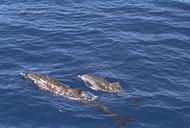
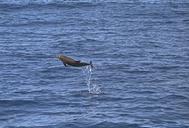
Note on the pictures
The photographs on this page were take on a whale-watching tour with Dan
McSweeney off the Big Island of Hawaii in November 1993.


 Back to the Dolphin
Page
Back to the Dolphin
Page Back to the Main
Page
Back to the Main
Page