 Back to the Dolphin
Page
Back to the Dolphin
Page Back to the Main
Page
Back to the Main
Page| Last modified: Tuesday September 22nd, 1999 |
Atlantic white-sided dolphinLagenorhynchus acutus(Gray, 1828) |
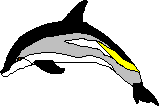
The Atlantic white-sided dolphin is black on the back, with dark grey flanks and a long white oval blaze below the dorsal fin, extending towards the anal area. Above the blaze there is a yellow-ochre band. The belly is white. They have a black ring around the eyes. The body is stocky and torpedo-shaped. The flippers are pointed and sickle-shaped. The dorsal fin is sickle-shaped and relatively tall. The tail stock is thick. Adults are 2.25-2.5 m long and weigh about 165 kg (maximum 3 m long, 250 kg (Peet et al, 1992). They have 29-40 pairs of small, sharp-pointed teeths in each jaw (Evans, 1987).
The Atlantic white-sided dolphin can be found in the temperate and sub-polar regions of the North Atlantic, from West Greenland, Iceland and the Barents Sea south to Cape Cod in the west and Ireland and the North Sea in the East. This is roughly the same distribution as the white-beaked dolphin, but the Atlantic white-sided dolphin is somewhat more pelagic. Inshore they are usually found in groups of 10-60 individuals. Offshore they are occassionally seen in herds of at least 1,000 animals. There are some indications, that immature animals and newly matures males are absent from larger breeding groups, indication some form of segregation among the herds. This species is usually found in colder waters (< 12°C, range 1-15°C) and in areas of relatively low salinity (Selzer and Payne, 1988).
Calves are born in spring or mid-summer after a 10 month gestation period. At birth the calves are 107-122 cm long. Lactation lasts 18 months. The calving interval is 2-3 years (Minasian et al, 1984). The (maximum) longevity is probably 27 years for females and 22 years for males (Klinowska, 1991).
No data is available on the size of the population. The species is considered to be regionally abundant. In the eastern North Atlantic the Atlantic white-sided dolphin population size is estimated to be about 40% of the size of the white-beaked dolphin population (relative estimate based on sightings. There is no absolute size estimate for either species) (Klinowska, 1991).
There has been drive fisheries for this species in a number of areas (Mitchell, 1975). Currently, some are taken in Greenland and the Faeroe Islands. There are incidental catches in fisheries throughout its range (Klinowska (1991), IWC (1996), Read (1994)). 45 animals were reportedly by-caught in Dutch fisheries in 1993 and 141 in 1994 (IWC, 1996). To date there has been no captive display of this species. A number of them have been housed temporarily in rehabilitation facilities in Boston and Harderwijk after stranding.
The Atlantic white-sided has a widely varied diet. Prey species include squid, herring, smelt and silver hake, as well as shrimp.
Recently, one Atlantic white-sided dolphin was seen getting trapped in a fishing net. Upon entanglement its companions took off at a speed of about 25 knots, abandoning the entangled dolphin (Weinrich, 1996)
|
Back to the Dolphin
Page |
Back to the Main
Page |